




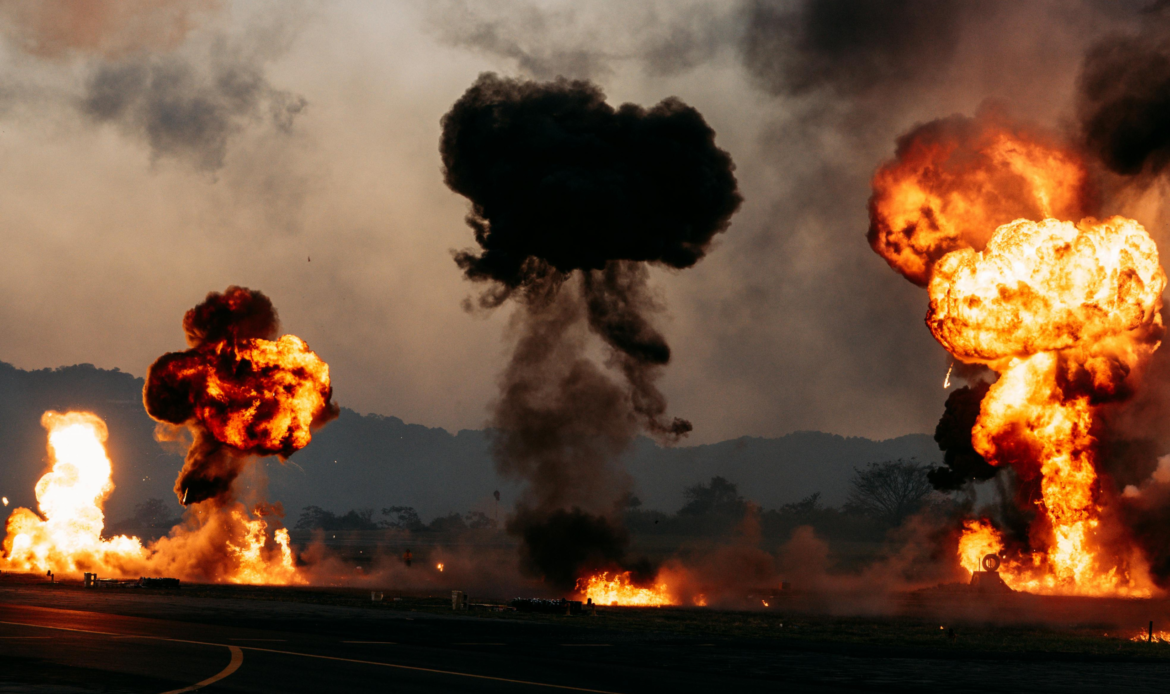
The war on Iran continues to pose serious problems for shipping. After initially focusing on ships attempting to transit the Strait of Hormuz, Iran is now also at tacking vessels anchored in the Gulf with missiles, as well as air and sea drones and mines. The country has hinted that it may continue its attacks even after any cessation of the current hostilities.
The most serious incidents so far occurred on 11 March, when sea drones hit two oil tankers carrying oil products in the northern Persian Gulf. These were the 72,000 dwt Safesea Vishnu and the 50,200 dwt Zefyros with both ships set on fire and one crew member dying. As for containerships, the MOL-owned and ONE operated 6,700 TEU ONE Majesty was hit above the waterline, causing an engine room fire, while the 3,200 TEU Source Blessing, operated by Maersk, was struck by fragments that caused a fire that was quickly extinguished.
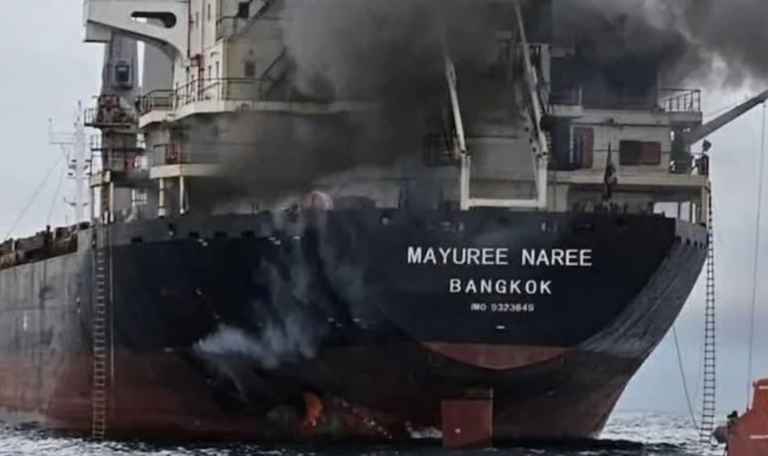
Despite US suggestions that it could escort ships through the Strait of Hormuz, and some insurers stating that they will continue to provide cover, the number of transits through the strait has fallen by 97%. In addition to the material risks faced by ships and their crews, inflated insurance premiums are preventing most operators from making the passage, with rates for a single VLCC transit under stood to be between USD 10 million and USD 14 million.
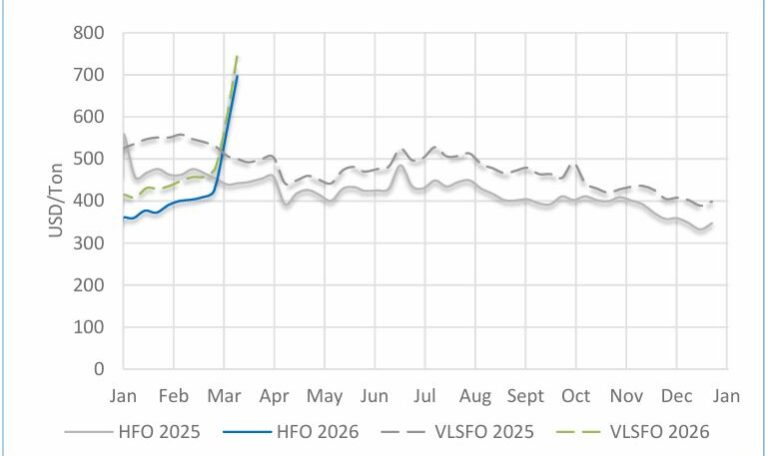
The crisis, which has constrained oil supply, has also led to a sharp rise in fuel prices worldwide. Compared with the start of the year, the price of HFO and VLSFO in Rotterdam has almost doubled to USD 697 and USD 746 per tonne respectively. In Singapore, the price of VLSFO has even surpassed the USD 1,000 per tonne threshold. Apart from the price increase, some ports, such as Salalah, are now also facing severe shortages forcing carriers to bunker elsewhere.
Carriers provide Middle East alternatives
The Gemini Cooperation (Hapag-Lloyd and Maersk) has announced a new service as an alternative for the Middle East countries, whilst avoiding the Strait of Hormuz. The AE19/SE4 will route its cargo via Jeddah on Saudi Arabia’s Red Sea coast, and provide onwards connections over land. Its rotation, with some stops yet to be filled in, is: Tianjin, Qingdao, Busan, Ningbo, Shanghai, Tanjung Pelepas, West Med hub, East Med Hub, Jeddah, West Med hub, East Med Hub, Singapore and back to Tianjin.
MSC now offers similar solutions using the existing Jade and Dragon services via the ports of King Abdullah (also Red Sea) or Jeddah. Inland connections include Dammam, Riyadh, Jubail, Bahrain, Kuwait, Hamad, Jebel Ali and Abu Dhabi. Additionally, MSC will offer a connection to Iraq (Zakho, Dohuk, Mosul, Erbil, Suleimaniya and Baghdad) via its Tiger and Phoenix service and transhipment at Mer sin in Southern Turkey. Meanwhile, CMA CGM launched a workaround for Iraq. It brings containers with the Phoenician Express (BEX2) to Mersin, from where it transports them to Dohuk, Ervil or Suleimaniya.
Gemini adapt network to Gulf situation
Due to the situation in the Middle East Gulf, the Gemini Cooperation has suspended Europe-Middle East IMX/ME11, the Far East-Middle East AGX/FM1 services and the local OGS/ME Shuttle 4, UG2/Middle East Shuttle 5 and UGS/Shaheen Express connections. Other services will be shortened with the Europe-Middle East/Indian Subcontinent IOS/ME1 service omitting Jebel Ali, and the Pakistan Service (PKS) now only calling Salalah, Karachi, Port Qasim and back to Salalah.
Source: DynaLiners 11/26 – 13 March 2026