




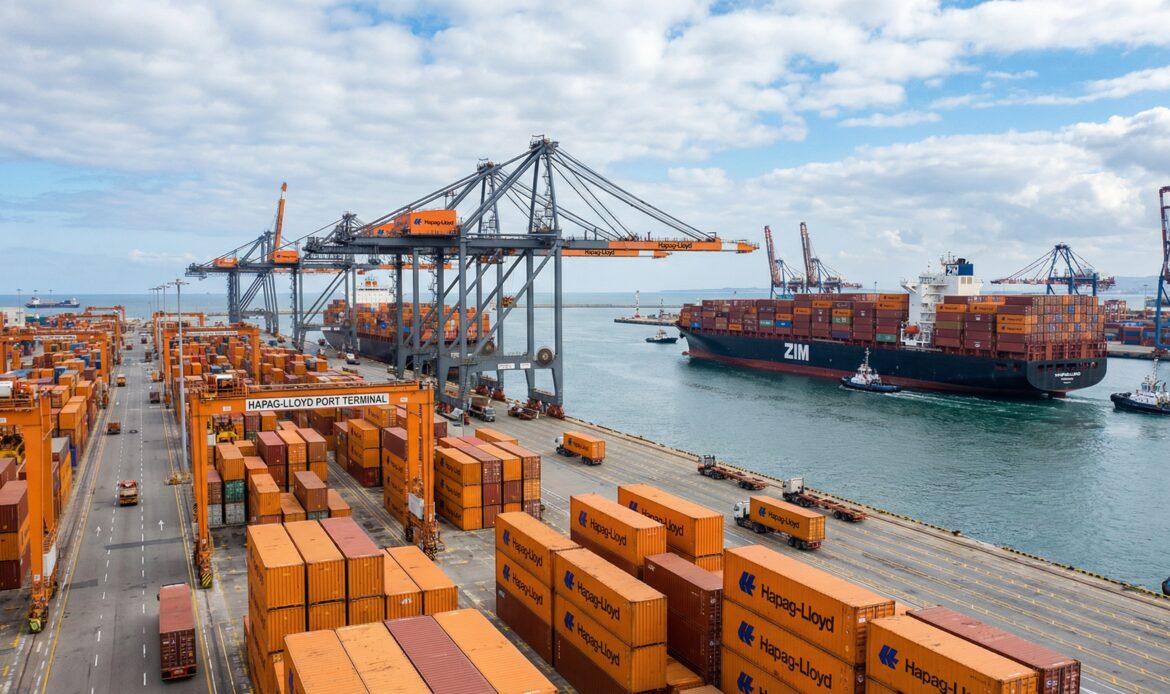
Hapag-Lloyd has signed an agreement with ZIM to acquire all of latter’s shares for USD 35 each in cash, representing a 58% premium over the recent trading price, at a total transaction value of approximately USD 4.2 billion. Subject to shareholder approval and regulatory clearance in several jurisdictions, Hapag-Lloyd will take control of ZIM’s international operations, while its Israel-centered activities will be acquired by Israel-based private equity fund FIMI Opportunity Funds. This structure has been chosen to circumvent ZIM’s golden share, which grants the Israeli government veto rights over key decisions.
ZIM is an asset-light carrier. Its fleet of 117 ships, with a total capacity of 704,500 TEU, includes only fifteen owned vessels, amounting to 92,900 TEU. The remainder is on long-term charter. In contrast Hapag-Lloyd operates 284 ships/2.38 million TEU, of which 1.45 million TEU is owned. The New ZIM will receive sixteen ships, including most of the owned vessels. Reportedly, this Israeli-owned carrier will operate three services, one to the US East Coast and two intra-Mediterranean loops. In addition, it will charter slots on the Gemini Cooperation network, in which Hapag-Lloyd partners with Maersk.
Hapag-Lloyd will absorb the other parts of ZIM’s network, including those of its subsidiary Gold Star Line. Under the ZIM brand, the carrier offers, among other services, a single Europe to Far East connection, two Transpacific services to the US West Coast and, together with MSC, three Transpacific services to the US East Coast. In addition, it operates a network of Latin America- elated services from the Far East, the United States and Europe. Under the Gold Star brand, it provides a range of Asia-focused connections linking with the Indian Subcontinent, sub-Saharan Africa and Australasia.
“We are and will remain committed also to staying in Israel with a significant presence. Otherwise we would not be investing so much money into this company.” -Hapag-Lloyd-
The acquisition of ZIM has not been welcomed by its employees. Even though Hapag-Lloyd said that is has no plans for mass layoffs, the labor unions claim that only 120 local staff might be offered jobs by the New ZIM, leaving around 880 workers at risk of redundancy. Also, shareholders appear not to be convinced, as despite the offer of USD 35 per share and a slight bounce in price, it is still trading well below USD 30. For comparison, the losing bid of Maersk was said to be USD 30.
“All ZIM’s headquarters employees and management will receive a job guarantee for a defined period after closing.” -Hapag-Lloyd-
Some history
ZIM, or ZIM Integrated Shipping Services in full, was founded in 1945 as the Zim Palestine Navigation Company, shortly before the establishment of the State of Israel. It became Israel’s national shipping line, playing a central role in transporting immigrants, goods and strategic supplies during the country’s early decades. For much of the twentieth century it operated both passenger and cargo services before focusing on containerized liner shipping as global trade evolved. The company expanded internationally but struggled financially at times, undergoing a major debt restructuring in 2014 that transferred control to its creditors. In 2021, it listed on the New York Stock Exchange, benefiting from the pandemic era freight boom, and subsequently returned substantial dividends to shareholders, which ultimately allowed its original shareholders to pull out.
Hapag-Lloyd traces its roots to 1847 founded Hapag in Hamburg, and the 1857 established Norddeutscher Lloyd of Bremen. They became major Transatlantic passenger and cargo carriers in the nineteenth and early twentieth centuries. After the decline of ocean liner passenger services, the two shifted decisively towards containerized shipping with their merger in 1970 to form Hapag-Lloyd AG.
Over subsequent decades Hapag-Lloyd expanded its global liner network, combining organic growth with acquisitions, including CP Ships in 2005, CSAV’s container business in 2014, UASC in 2017, NileDutch in 2021 and the liner operations of DAL in 2022. It operates a worldwide network and is particularly strong on the Transatlantic -a legacy of its origins and the CP Ships purchase- and through the inherited networks of CSAV and UASC, also on Latin America and Middle Eastern trades. It benefited significantly from the post-COVID freight rate boom, allowing it to invest heavily in terminals and now in ZIM.
Source: DynaLiners 08/26 – 20 February 2026