





Little more than a day after its launch, and after only two vessels were publicly reported to have used it, the United States suspended Project Freedom, which was intended to challenge the Iranian blockade of the Strait of Hormuz by escorting ships out of the Persian Gulf. One of the vessels was the U.S.-flagged vehicle carrier Alliance Fairfax, operated by Maersk’s U.S. subsidiary Farrell Lines and enrolled in the U.S. Maritime Security Program. The second one was the U.S. flagged chemical tanker CS Anthem, operated by Crowley-Stena Solutions.
Outside the framework of Project Freedom, CMA CGM attempted to move two vessels out of the Gulf: the CMA CGM San Antonio and the CMA CGM Saigon. While the CMA CGM Saigon appears to have emerged unharmed, the CMA CGM San Antonio was reportedly targeted while transiting the Strait of Hormuz, resulting in injuries among crew members and damage to the vessel. Its current whereabouts remain unclear.
Another vessel that may have been affected by hostile activity was the HMM-operated HMM Namu, which experienced an explosion and fire in or near the engine room, damaging its propulsion system. The fire was extinguished, but the vessel was left unable to move under its own power. South Korean authorities have not yet confirmed the cause; a drifting mine has been mentioned as a possible explanation.
Even if the Strait of Hormuz reopens more fully, Iran appears intent on retaining a degree of control over passage and charging transit fees. To that end, it says it has launched the Persian Gulf Strait Authority, through which carriers can arrange transit by email. Once carriers have met the required conditions, they can obtain authorization for passage, although the legal status and practical enforce ability of this mechanism is obviously disputed.
Although both Iran and the United States treat the Strait of Hormuz as effectively closed, with the United States trying to block vessels with connections to Iran, some traffic has been possible, albeit at declining levels. This covers ships of all types, as illustrated in the graph below from Lloyd’s List Intelligence. Although the number of transits by cargo-carrying vessels over 10,000 dwt dropped to below forty in the first week of May, the actual number may be higher, as some vessels may have transited without being detected. Interestingly, despite the U.S. blockade, the number of ships with links to Iran has not declined significantly, if at all.
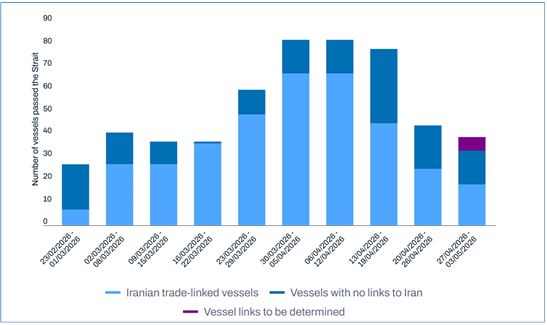
Source: DynaLiners 19/26 – 8 May 2026
