




Through social media activity and political statements, Iran’s intended approach to control transits of the Strait of Hormuz is beginning to take shape. One mechanism involves the so-called Persian Gulf Strait Authority, which appears analogous to the Panama and Suez Canal authorities only in that it will manage Strait traffic and charge fees for transiting vessels. The other is the Hormuz Safe insurance scheme, which would rely upon bitcoin or similar and would apply to vessels making the same transit.
Adding a little more detail, the Persian Gulf Strait Authority has announced the extent of its ‘regulatory jurisdiction’, as defined by itself. This extends much further to the east and west of the Strait of Hormuz itself and notably includes the territorial waters of the UAE and Oman, thereby incorporating the immediate
maritime hinterland of ports as Khor Fakkan and Fujairah.
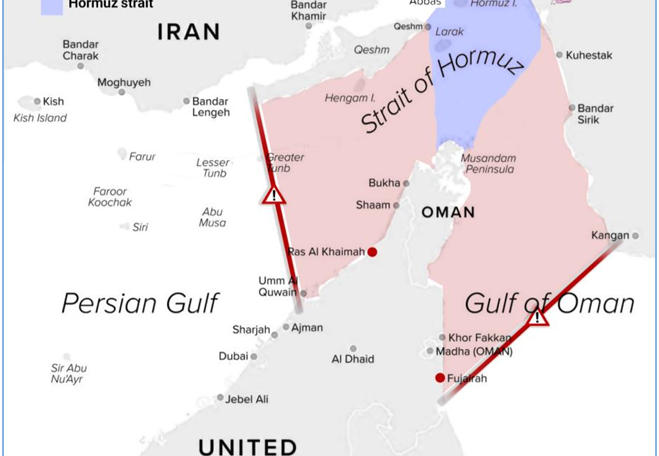
Hormuz questions and concerns
Questions of (international) legality aside, if the Persian Gulf Strait Authority becomes operational, what vessels will want or be allowed to transit? On the one side, it is conceivable that not every vessel – depending upon its affiliations and associations – will be allowed to pass. And if some are barred, would they look to friendly naval (military) assistance to help force a passage?
On the other side of the equation, should any vessel transit the Hormuz Strait under these management (and/or insurance) conditions, could they face interception and redirection at sea from other actors in the area? And even if they manage to transit without interference, that ship and others affiliated or associated with it would surely be falling foul of sanctions imposed upon Iran by multiple countries.
Source: DynaLiners 21/26 – 22 May 2026
