




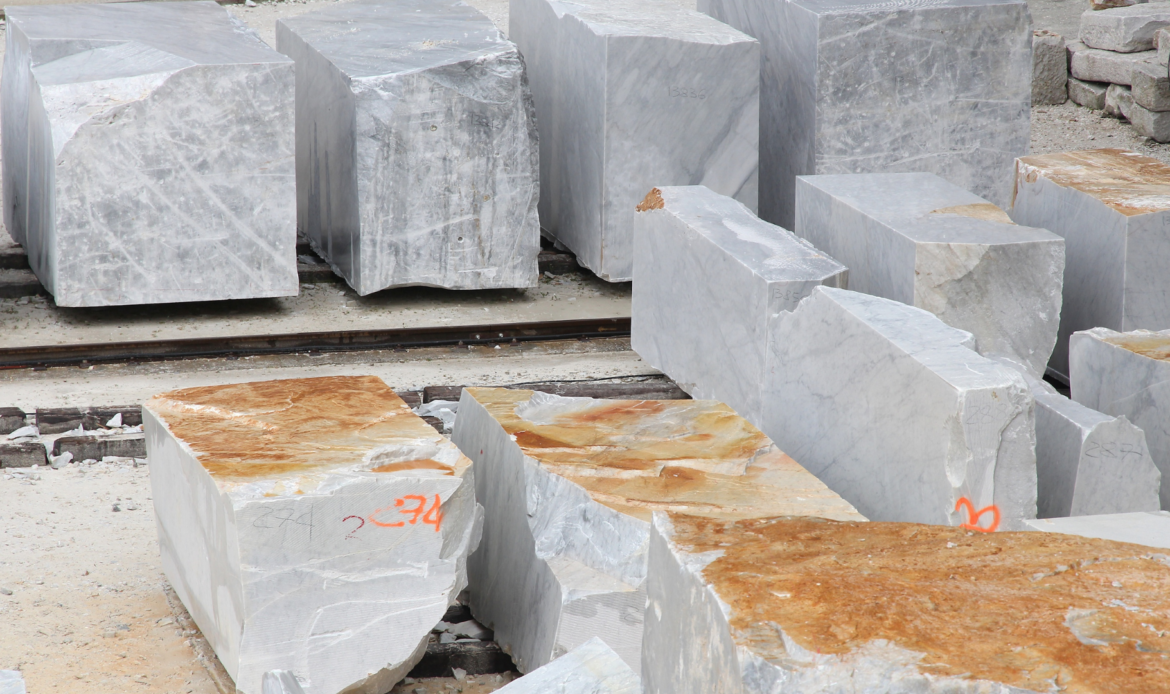
Greece ranks second in Europe in terms of marble production and the marketing of marble products. More than 80% of the country’s marble output is exported, with 73% of those exports originating from northern Greece.
Industry representatives say marble is one of the sustainable building materials and that Greece has vast underground reserves with very strong characteristics. However, a number of challenges continue to cloud the outlook for the sector.
Marble exports 2015-2025
The highest level of marble exports was recorded in 2018, when their value exceeded €315 million and volumes reached 813,000 tonnes. The lowest point came in 2015, when exports were worth €183.3 million and totalled 527,700 tonnes.
New markets
Against this backdrop, the concentration of marble exports in five markets — China, Algeria, Egypt, Saudi Arabia and Cyprus — highlights the need for greater geographical diversification to reduce vulnerability to external shocks, as well as for a strategic repositioning of Greek export production towards higher-value products that are more resilient to external fluctuations.
In terms of geographical diversification, Algeria has already recorded its second-highest export value of the past 11 years. Exports to Egypt have also recorded continuous growth in value over the past three years. Tunisia remains a stable, mid-sized destination, while exports to Italy have increased significantly over the past two years.
India, meanwhile, recorded the second-highest performance of the period in both value and volume terms. Between the first quarters of 2025 and 2026, the value of exports to India increased by 63.88%, while volumes rose by 31.94%.
The development is particularly significant, indicating that India is not merely a market capable of absorbing large volumes, but one where Greek marble can pursue stronger commercial positioning, higher added value and more systematic links with technical, architectural and investment circles.
Source: www.naftemporiki.gr