




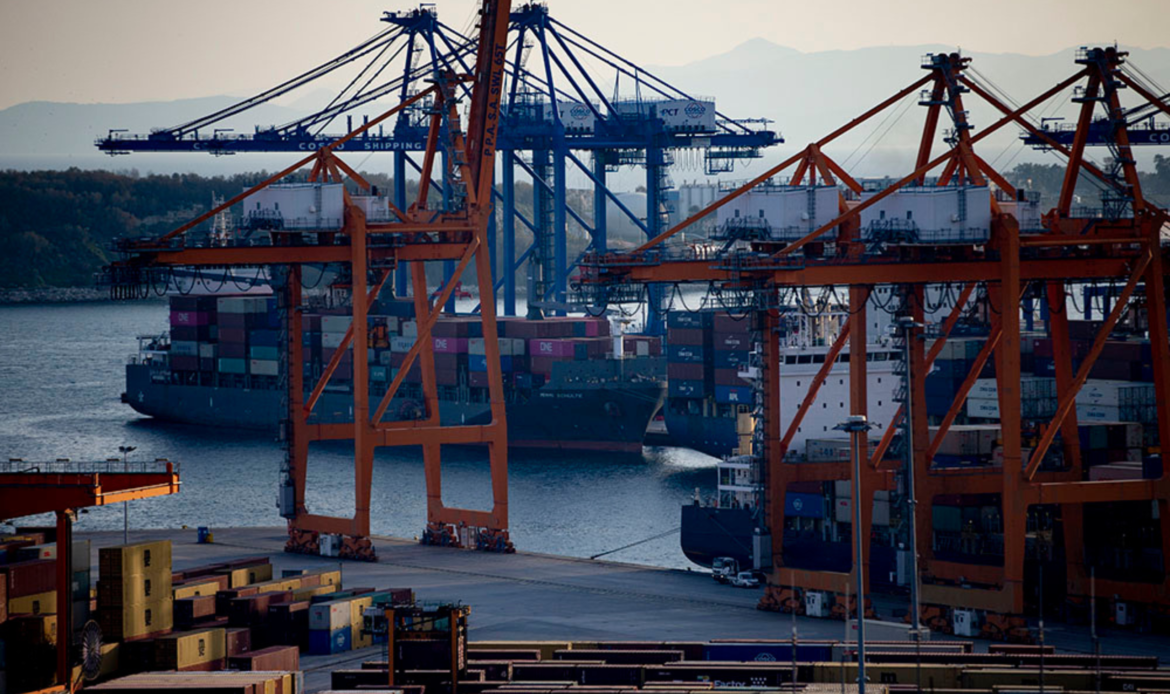
The Port of Piraeus is resilient to the disruptions caused by the conflict in the Middle East on global supply chains. However, downward pressure is now beginning to be reflected in volumes handled at Piers II and III of the container terminal operated by Piraeus Container Terminal (PCT).
Pressure on volumes
According to data from COSCO Shipping Ports, throughput at Piers II and III of the container terminal at the Port of Piraeus declined by 5.1% year-on-year in March 2026, reaching 339,000 TEUs compared to 357,000 TEUs in the same month of 2025. This decline reflects disruptions in cargo flows and subdued demand driven by the unstable international environment.
In the first-quarter, total throughput reached 962,000 TEUs versus 1.019 million TEUs in the same period last year, marking a 5.6% decrease. This trend suggests that the pressures are not merely temporary but are taking on a more structural character, as key trade flows through the Eastern Mediterranean are being affected.
Strong performance at group level
However, the Group presents a significantly different dynamic. COSCO Shipping Ports recorded a 6.7% increase in total throughput across its 38 ports worldwide in March 2026, reaching 10.3 million TEUs compared to 9.7 million TEUs in March 2025. This upward trend was also confirmed in the first quarter, with volumes reaching 28 million TEUs, up 9% from 27 million TEUs in the corresponding period last year.
Performance in China was particularly strong, with terminals in the Bohai Rim region recording a 5.2% year-on-year increase, underscoring steady domestic demand. An even higher growth was observed at the Group’s international terminals, which continued their upward trajectory with an impressive 20.4% increase in throughput. The divergence between Piraeus’ declining volumes and the Group’s overall growth highlights the decisive role of geopolitical developments in shaping global trade flows. Nevertheless, despite these pressures, the Port of Piraeus maintains its strategic role as a key logistics hub for the Eastern Mediterranean and Southeast Europe.
Source: www.naftemporiki.gr
